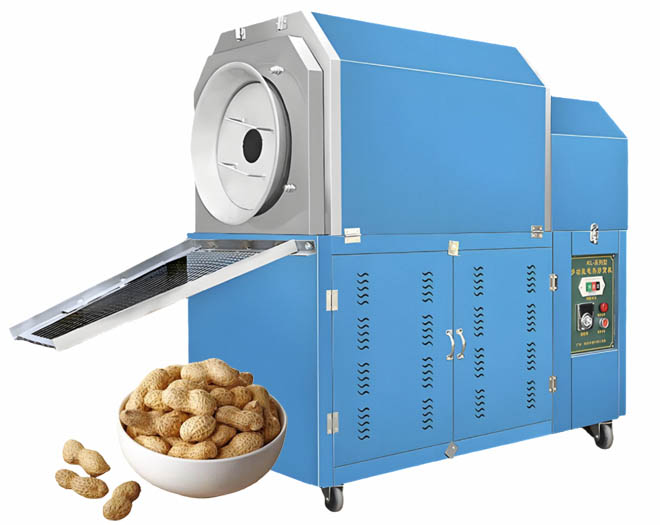

Roasted chestnuts, known as tángchǎolìzi in China, are a beloved seasonal street food across East Asia and Europe . While traditional manual roasting is labor-intensive and produces inconsistent results, a modern chestnut roasting machine—whether a commercial nut roaster or a compact countertop unit—eliminates the dust and guesswork. However, the quality of the final product depends heavily on proper preparation before the machine is even switched on.

The following are the materials needed for the roaster machine.
1. Selecting and Preparing the Raw Chestnuts
Selection Criteria: Choose chestnuts that are uniform in size and shape. This prevents small nuts from over-roasting while large ones remain undercooked. The shells should be free of worm holes, cracks, or signs of mold. A light powder-like coating on the shell is often a sign of freshness, but avoid nuts that feel unusually light or rattle when shaken, as this indicates desiccation.
The Critical Step of Scoring: Before loading the nut roaster, every chestnut must be scored. Using a sharp knife or a specialized chestnut scorer, make a shallow cut—approximately 1/8 inch deep—across the rounded side or in an “X” pattern on the flat side . This step is non-negotiable for two scientific reasons. First, it prevents the nuts from exploding due to internal steam pressure buildup during high-temperature roasting . Second, scoring creates a pathway for heat to penetrate more efficiently and allows the shell to peel back easily after cooking, revealing the kernel without tearing it .
2. The Role of Thermal Media: Selecting the Right Stone or Sand
Traditional sugar-roasted chestnuts rely on a bed of black stones or sand. In a chestnut roasting machine, this medium serves as a critical heat exchanger.
Material Specifications: Do not use ordinary garden gravel. The optimal medium is a specialized quartz sand or ceramic bead mixture designed for high-temperature conduction . These materials possess a thermal conductivity that sits between the cast-iron drum and the chestnut shell, ensuring heat is transferred gently and evenly without scorching the shell .
Maintenance and Screening: The stones must be washed with clean water and thoroughly dried before use. If the medium has been used three to four times, it should be screened to remove debris and broken fragments. Over time, sugar and resin buildup can cause the stones to clump, reducing their ability to coat the nuts evenly and dulling the final luster of the chestnuts.

3. Sugar Syrup Formulation and Its Scientific Function
A common misconception is that sugar is used primarily for flavor. In professional nut roaster operations, the syrup serves a dual purpose: it acts as a polishing agent and a heat-transfer facilitator.
Preparation Ratio: Dilute approximately one spoonful of maltose or corn syrup with five to eight spoonfuls of warm water. Maltose is preferred over sucrose because it resists crystallization and provides a more stable, glossy coating .
Mechanism of Action: When the diluted syrup is introduced into the hot stone bed, it does not simply sweeten the chestnut. The sugar water coats the hot stones, creating a sticky surface that allows fine sand particles to adhere to the chestnut shells. This layer acts as a “secondary conductor,” transferring heat more uniformly. Simultaneously, the caramelization of the sugars—driven by the Maillard reaction between reducing sugars and amino acids—produces the characteristic aromatic compounds and deep mahogany sheen associated with premium roasted chestnuts . The sugar also helps clean the shell, removing ash and impurities.
4. Continuous Sorting and Quality Control
Roasting is not a “set and forget” process. Even with a high-quality chestnut roasting machine, manual oversight is required.
Real-Time Screening: As the drum rotates and heat penetrates, some chestnuts will inevitably crack open prematurely or reveal defects. These must be removed promptly. Open chestnuts will dry out rapidly, becoming hard and unpalatable, and they can also leak starch onto the stones, causing them to clump. Remove any nuts with excessively large cracks, signs of bug infestation, or those that feel unusually light.
5. Machine Calibration and Pre-Heating
Before adding the chestnuts and stones, pre-heat the chestnut roasting machine to the recommended operating temperature. Most commercial machines operate between 180°C and 220°C, depending on the drum design. Pre-heating ensures that the stones are uniformly hot before contact with the raw nuts, preventing a slow start that can cause the chestnuts to dehydrate rather than roast. For operators using a nut roaster with a ceramic-coated drum, note that far-infrared radiation can contribute to a more uniform roast, though the stone medium remains essential for surface luster .
Above are the materials we need to prepare for the roasting of chestnuts. If you also want to make delicious and good-looking chestnuts, you can purchase a chestnut roaster machine to meet your needs.
FAQ:
Q1: Can I skip scoring the chestnuts if my chestnut roasting machine has a closed drum?
No. Even in a closed, rotating drum, the internal moisture of the chestnut turns to steam rapidly. Without a vent (the score line), the pressure will cause the nut to explode, creating a mess and potentially damaging the batch. Always score.
Q2: How often should I replace the roasting stones?
There is no fixed timeline, but inspect the stones monthly. If the stones appear rounded, heavily coated with carbonized sugar, or are producing excessive dust, replace them. Well-maintained quartz sand can last for many seasons, but screening after every 3–4 uses is mandatory to maintain luster.
Q3: Why do my chestnuts look dull after roasting?
Dullness usually indicates insufficient sugar coating or over-cleaning of the stones. Ensure your maltose solution is fresh and that the stones are not washed with soap—residual soap kills the gloss. Additionally, roasting at too high a temperature can burn the sugar before it coats the shell.
Q4: What is the ideal chestnut variety for a nut roaster?
Asian varieties (Castanea crenata and C. mollissima) and European chestnuts (C. sativa) are both suitable . For machine roasting, look for varieties with a high sugar content (14–20% dry weight) and a single kernel per shell, as these yield the best texture and peeling experience .