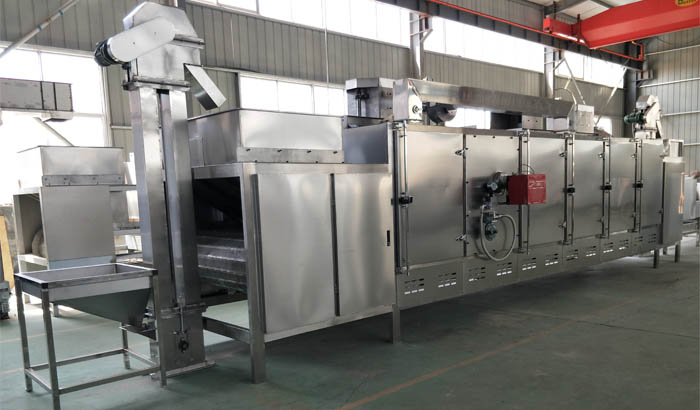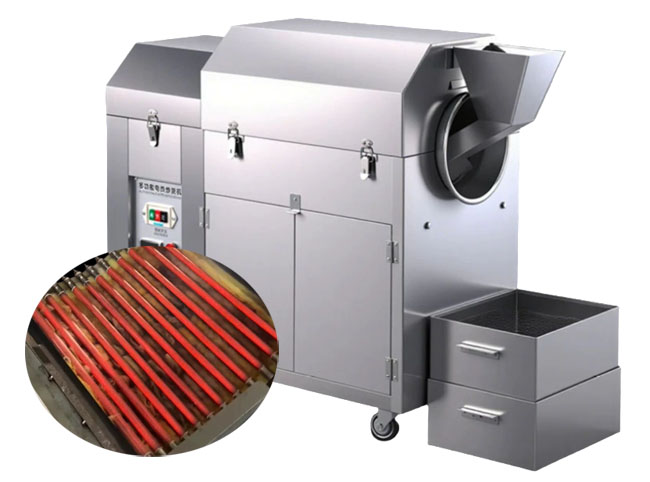

In the process of peanut roasting, electric heating and gas heating are two common heating methods. There are significant differences in maintenance between them. Understanding these differences is essential for plant managers, food processing technicians, and small-scale roastery owners. The following four aspects are analyzed: heating parts, cleaning priorities, safety maintenance and troubleshooting difficulty.
1. Different Heating Elements
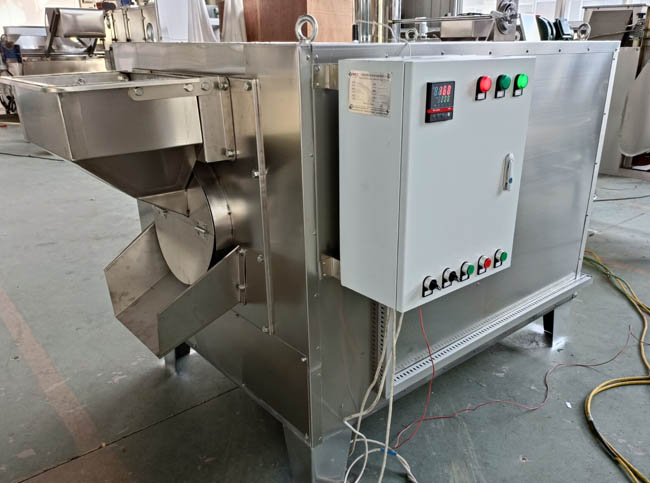
Electric peanut roasting machines rely on resistance heating tubes (typically stainless steel tubes coated with a magnesium oxide insulating layer) or open-coil heating wires for heating. These elements are installed in the roasting drum or chamber and feature a compact, modular design with few moving parts.
Gas peanut roasters, on the other hand, use forced-draft burners, gas solenoid valves, pressure regulators, and complex piping systems (made of stainless steel or coated copper tubing). The combustion system includes ignition electrodes and flame sensors (ultraviolet or ionization-type).
Key Point: Electric roasting systems prioritize electrical safety; gas roasting systems require mechanical and pneumatic safety measures.
2. Different Cleaning Focuses
Electric Roasters—The primary cleaning challenge lies in removing carbonized peanut oil and fine peanut skin particles adhering to the heating tubes. These substances act as thermal insulators, reducing heat transfer efficiency by 15–20% and increasing energy consumption.
Gas Roasters—In addition to cleaning the roasting drum, special attention must be paid to the exhaust flue, heat exchanger, and burner ports. Incomplete combustion caused by soot buildup produces carbon monoxide (CO), which reduces thermal efficiency.
Pro Tip: For gas equipment, install an exhaust backpressure gauge to monitor exhaust backpressure—when backpressure rises above 0.5 inH₂O, it indicates that cleaning is needed.
3. Different safety maintenance
In the safety maintenance of electric heating roaster, we mainly pay attention to the insulation of the circuit and the integrity of the grounding device to prevent leakage accidents. The gas heating roaster focuses on the sealing inspection of the gas pipeline and the running state of the burner. Gas leakage will bring serious safety risks, so it is necessary to regularly detect whether there is gas leakage and use special equipment to monitor it.
Regulatory note: Many jurisdictions require annual third-party inspections for gas-fired equipment, while electric units often only need in-house electrical safety audits.
4. Difficulty in troubleshooting
Comparatively speaking, the troubleshooting of electric roaster is relatively simple, and problems can usually be found by checking circuit connection and resistance value. However, gas heating peanut roaster involves combustion system and various mechanical parts, and the troubleshooting is complicated, which requires professional tools and experienced technicians to carry out testing.
Cost consideration: Spare parts for gas systems (valves, regulators, flame scanners) are 2–3× more expensive than electric heating elements, and labor rates for gas-certified technicians are significantly higher.
Final Recommendation: Tailor Your Maintenance Plan
| Aspect | Electric Roaster | Gas Roaster |
|---|---|---|
| Daily checks | Visual inspection of wires, control panel | Flame color, gas odor, vent operation |
| Weekly tasks | Clean tube surfaces, test ground | Clean burner nozzles, check gas pressure |
| Monthly tasks | Measure insulation resistance | Leak test, flue gas analysis, clean heat exchanger |
| Quarterly tasks | Replace aging contactors, calibrate sensors | Inspect entire gas train, replace gaskets |
| Annual overhaul | Full electrical safety audit | Certified combustion efficiency test |
In a word, electric heating peanut roasting machine and gas heating peanut roasting machine have their own emphasis on maintenance. Users should make corresponding maintenance plans according to the type of peanut roaster equipment to ensure the safe and efficient operation of the equipment and prolong the service life.