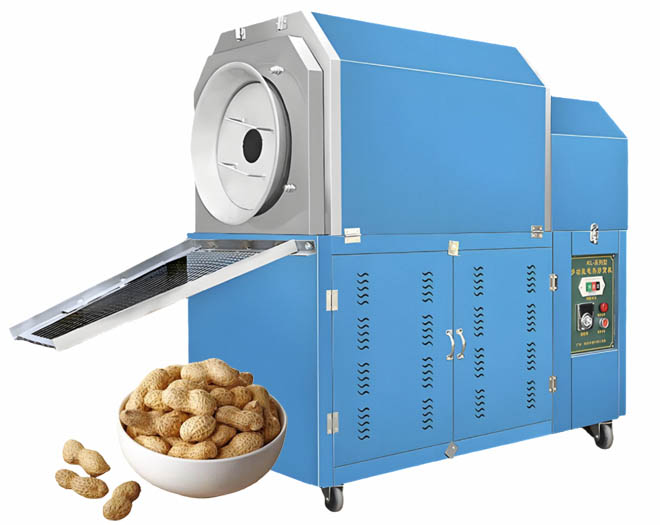

The peanut roasting production line takes electricity as heat source with flow fan acting on the heat exchanger to heat the air in a convection way. In order to improve the drying quality of peanut roasting machine, people adopt a lot of methods. The following sections detail the technical pathways for enhancing drying quality within the peanut roasting production line.

Technical Strategies for Quality Optimization
To elevate the drying quality beyond the basic circulation model, modern peanut roasting production line designs incorporate several advanced technical interventions.
1. Precision Control of Airflow Dynamics and Plenum Design
Uniform drying is not merely a function of temperature but of airflow distribution. In advanced peanut roasting machine architectures, dual-plenum designs are utilized to deliver consistent exposure of heated air to the entire product bed. High-velocity air is directed from the left and right sides of the conveyor, as well as from above and below, ensuring even roasting and drying without cold or hot spots . This is particularly vital for peanuts, which, due to their varying moisture content after washing, can otherwise suffer from uneven roasting and inconsistent mouthfeel .
2. Integrated Humidification and Maillard Reaction Management
While the primary goal is drying, uncontrolled rapid surface dehydration can impair the Maillard reaction, leading to a less intense aroma and poor texture. High-quality peanut roasting production line systems now integrate humidification capabilities. By preventing excessively rapid surface drying, the system enhances the Maillard reaction, resulting in a more intense roasted flavor and uniform product quality . Furthermore, gentle pasteurization at lower temperatures—enabled by precise humidity control—can improve microbial safety by up to 20% while reducing the formation of acrylamide, a potential processing contaminant .
3. Energy Recirculation and Exhaust Management
The principle described in the original design—where most hot air is cycled internally—is the foundation of energy efficiency. Modern implementations optimize this further. By utilizing precisely controlled airflow, pressure regulation, and efficient air recirculation, a well-engineered peanut roasting production line can achieve energy savings of up to 30% to 50% . The key is the continuous, modulated discharge of saturated air and the introduction of fresh air, which maintains the driving force for moisture evaporation without unnecessary heat loss.
4. Material Handling and Bed Uniformity
The physical interaction between the peanut roasting machine and the product is critical. In continuous belt roasters, the hopper feeder must create a uniform product bed before the peanuts enter the drying zone. Internal baffles and level sensors regulate the flow to ensure a consistent stream onto the conveyor belt . A uniform bed depth guarantees that every peanut experiences the same airflow resistance and heat transfer conditions. Additionally, gentle handling at the discharge point prevents breakage and chipping, preserving the integrity of the final product .

Optimizing the drying quality of a peanut roasting production line requires a holistic approach that balances thermodynamic efficiency with product-specific constraints. By moving beyond basic hot-air circulation to incorporate precision airflow plenums, integrated humidification for reaction control, and intelligent energy recirculation, processors can significantly enhance product uniformity, sensory quality, and operational cost-efficiency. These technical refinements ensure that the peanut roasting machine delivers consistent, high-value output suitable for demanding global markets.
FAQ:
Q1: What is the ideal temperature range for drying peanuts in a peanut roasting machine?
A: The ideal drying temperature typically ranges between 140°C and 160°C (284°F–320°F), depending on the desired roast profile and final moisture content. However, the key to quality is not just the absolute temperature but the stability of the temperature curve throughout the peanut roasting production line. Fluctuations of more than ±5°C can cause uneven drying and inconsistent color development. Modern peanut roasting machine systems use PID (Proportional-Integral-Derivative) controllers to maintain temperature within ±1°C of the set point, ensuring repeatable results batch after batch.
Q2: How does humidity control affect the final quality of roasted peanuts?
A: Humidity control is a often-overlooked but critical variable. If the relative humidity in the drying chamber is too low, the peanut surface dries too rapidly, which can stall the Maillard reaction and produce a bland, pale product. Conversely, if humidity is too high, drying efficiency drops and the risk of mold growth increases. The optimal approach is staged humidity control: higher humidity in the early roasting phase to promote flavor development, followed by reduced humidity in the final drying phase to achieve the target moisture content (typically 2–4% for shelf-stable peanuts). This is why advanced peanut roasting production line designs incorporate adjustable exhaust dampers and fresh-air intake modulation.
Q3: Can a peanut roasting machine handle different peanut varieties and sizes?
A: Yes, but with adjustments. Different peanut varieties (e.g., Virginia, Runner, Spanish) and seed sizes have varying densities, moisture contents, and thermal conductivities. A well-designed peanut roasting machine allows operators to adjust belt speed, airflow velocity, and temperature set points to accommodate these differences. For optimal results, it is recommended to calibrate the peanut roasting production line for each incoming lot by running a small test batch and measuring final moisture content and color (using a Hunter Lab or similar colorimeter). Some modern systems include recipe management functions that store parameter sets for different products, enabling quick changeover.
Q4: How does the peanut roasting production line reduce acrylamide formation?
A: Acrylamide is formed when asparagine (an amino acid) reacts with reducing sugars at temperatures above 120°C. To minimize acrylamide while maintaining flavor, the peanut roasting production line can employ several strategies: (1) pre-drying at lower temperatures (below 120°C) to reduce surface moisture before high-temperature roasting; (2) controlling pH by slightly lowering it (e.g., through citric acid treatment), which inhibits acrylamide formation; (3) optimizing the time-temperature profile to achieve desired color and flavor with minimal acrylamide generation; and (4) using humidification to keep surface temperatures lower during the early roasting phase. Studies have shown that these measures can reduce acrylamide levels by 30–50% without significantly compromising sensory quality.